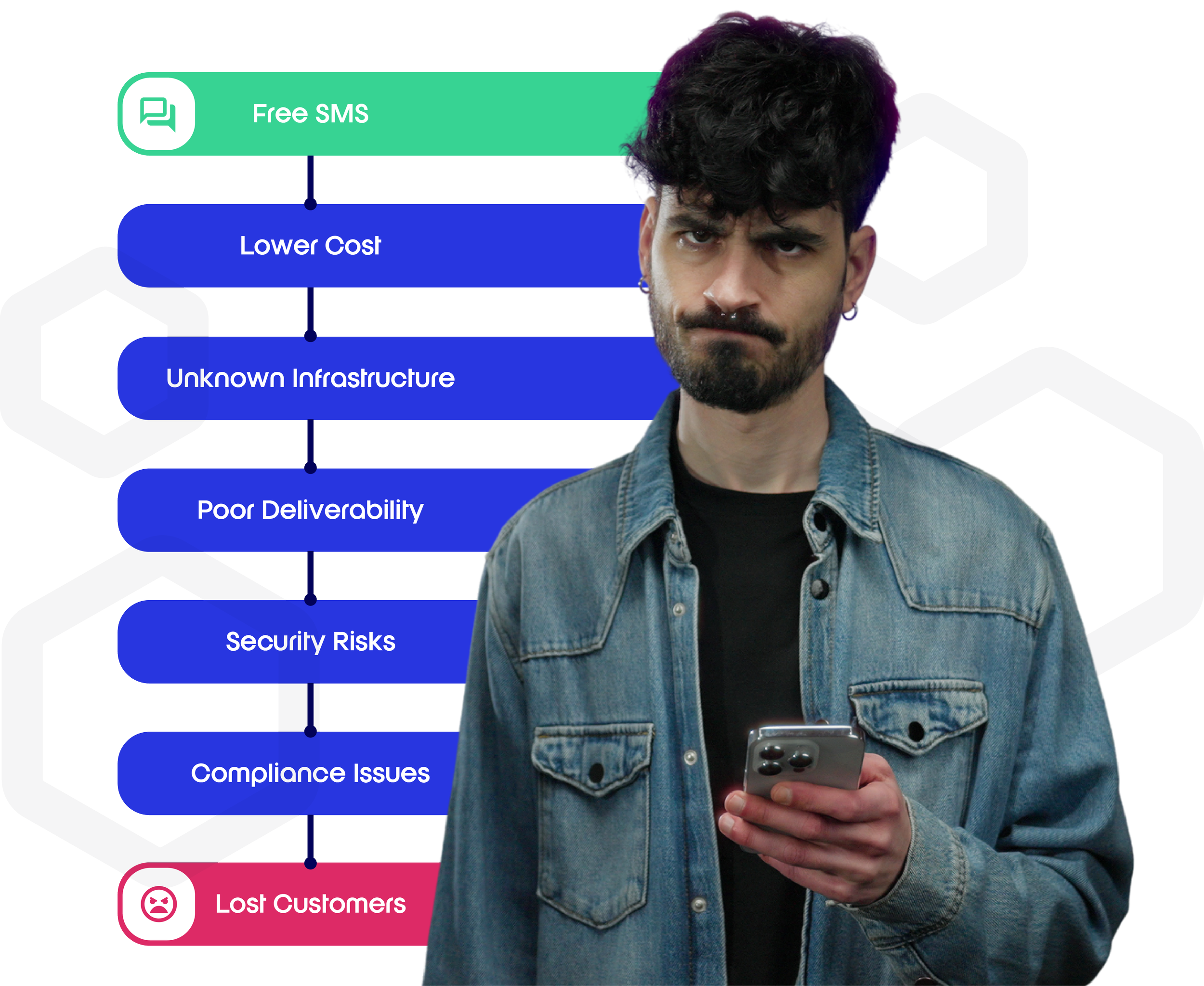
Businesses searching for free SMS online services often have one goal in mind: reducing communication costs. At first glance, the appeal is obvious. If a platform allows you to send messages for free, why pay for enterprise messaging services?
The reality is more complicated.
Many free SMS platforms operate with significant limitations around security, data protection, deliverability, compliance, and message reliability. While they may be suitable for occasional personal use, they rarely meet the requirements of businesses handling customer communications, authentication codes, appointment reminders, or operational notifications.
For SaaS providers, SMEs, platforms, and organisations handling customer data, choosing the wrong messaging provider can create security risks, regulatory exposure, and reputational damage.
This guide explains how free SMS services work, the risks businesses should understand, and why professional messaging infrastructure remains essential for business communications.
Contents
- What Is Free SMS Online?
- Why Businesses Search for Free SMS Services
- The Security Risks Behind Free SMS Online Platforms
- GDPR and Data Protection Concerns
- Message Filtering and Deliverability Problems
- Why Business Messaging Requires Professional Infrastructure
- Choosing an SMS Provider: Questions Every Business Should Ask
- Key Takeaways
- Frequently Asked Questions
- Discuss Your Messaging Requirements
What Is Free SMS Online?
The term free SMS online generally refers to websites or applications that allow users to send SMS messages without directly paying per message.
These services typically fall into several categories:
Ad-supported messaging platforms
Free trial SMS services
SMS gateway demonstrations
Virtual number services
Community-funded messaging platforms
Services monetised through user data collection
Many platforms advertise terms such as:
Free SMS
SMS online
Send SMS free
Free text messaging
Online SMS service
The challenge is that "free" often means the service generates revenue elsewhere.
That may involve advertising, data collection, message analysis, upselling, traffic arbitrage, or routing messages through lower-quality delivery paths.
For businesses, understanding this distinction is critical.
Why Businesses Search for Free SMS Services
Search interest around free sms and sms online continues because organisations are under pressure to reduce communication costs.
Common business use cases include:
Customer Notifications
Retailers and service providers often need to send:
Delivery updates
Appointment reminders
Account notifications
Service alerts
User Authentication
Software companies regularly send:
One-time passwords (OTPs)
Multi-factor authentication codes
Login verification messages
Marketing Communications
Businesses may use SMS for:
Promotional campaigns
Event invitations
Customer engagement
Loyalty programmes
Operational Communications
Internal teams often rely on SMS for:
Staff alerts
Incident notifications
Emergency communications
In each case, message delivery and security matter far more than simply reducing cost.
A message that never arrives can cost considerably more than the few pence saved on transmission.
The Security Risks Behind Free SMS Online Platforms
Security is one of the biggest concerns associated with free messaging services.
Many providers offer limited information about:
Data storage locations
Security controls
Access management
Message retention policies
Third-party data sharing
This creates uncertainty around how customer information is handled.
Message Content Exposure
SMS messages frequently contain sensitive information, including:
Customer names
Account references
Appointment details
Verification codes
Internal business information
If platform operators lack appropriate security controls, messages may be exposed to unauthorised access.
Unknown Infrastructure
Many free services provide little transparency regarding:
Network routing
SMS gateways
Carrier relationships
Data processing arrangements
Businesses often have no visibility into where messages travel or who can access them.
Limited Security Certifications
Enterprise messaging providers increasingly operate under recognised security frameworks.
Businesses should look for providers with credentials such as:
ISO 27001 certification
SOC 2 compliance
Documented security controls
Auditable operational processes
Without these safeguards, organisations may struggle to demonstrate due diligence when handling customer communications.
GDPR and Data Protection Concerns
For UK businesses, GDPR compliance remains a major consideration when evaluating any SMS platform.
The UK GDPR and Data Protection Act require organisations to understand how customer data is processed, stored, and protected.
Free messaging services can create several challenges.
Unclear Data Processing Arrangements
Businesses need answers to questions such as:
Where is data stored?
Which countries process the information?
Who has access to customer records?
How long are messages retained?
Many free SMS platforms provide limited transparency around these issues.
Data Processor Responsibilities
If an SMS provider processes customer information, it may act as a data processor under GDPR requirements.
Organisations remain responsible for selecting processors that provide appropriate safeguards.
Failure to do so can create compliance exposure.
Consent and Marketing Requirements
Businesses using SMS for marketing must also ensure compliance with:
UK GDPR
PECR regulations
Consent requirements
Opt-out obligations
Free messaging platforms rarely provide the governance tools required to manage these obligations effectively.
Message Filtering and Deliverability Problems
One of the least understood risks associated with sms online platforms is message filtering.
Mobile operators continuously monitor messaging traffic to combat:
Spam
Fraud
Phishing attacks
Smishing campaigns
Artificial traffic generation
As a result, low-quality routes frequently experience filtering.
Shared Infrastructure Problems
Many free services rely on heavily shared infrastructure.
This means legitimate business traffic may be affected by the behaviour of other users on the same platform.
If another sender generates spam complaints, delivery performance can suffer across the entire service.
Lower-Quality Routing
To minimise costs, some providers route traffic through indirect or grey routes.
Potential consequences include:
Delayed delivery
Reduced delivery rates
Message blocking
Inconsistent international reach
For customer communications, these issues quickly become operational problems.
Authentication Messages Are Especially Sensitive
Authentication codes and login verification messages depend on fast, reliable delivery.
A delayed verification code can:
Prevent user access
Increase support tickets
Reduce customer satisfaction
Create security concerns
For SaaS providers, dependable delivery is usually worth far more than the marginal savings offered by free services.
Why Business Messaging Requires Professional Infrastructure
Business messaging differs significantly from casual person-to-person texting.
Organisations require:
Reliable delivery
Security controls
Compliance support
Reporting visibility
Scalability
Technical support
This is where enterprise messaging providers operate differently.
Direct Network Relationships Matter
Providers with direct operator relationships typically offer greater visibility into:
Routing quality
Delivery performance
Compliance requirements
Traffic management
As an independent UK mobile network operator regulated by Ofcom, Stour provides wholesale messaging infrastructure through direct operator relationships rather than relying solely on intermediary routes.
This creates greater transparency and control for organisations handling critical communications.
Enterprise Security Standards
Professional messaging providers generally support:
Audited security frameworks
Controlled access environments
Secure APIs
Documented data governance
Compliance reporting
These capabilities are increasingly expected by enterprise customers and regulators.
Operational Support
When delivery issues occur, businesses need access to technical expertise.
Free services rarely provide:
Dedicated support
Network visibility
Escalation processes
Routing diagnostics
For organisations that depend on messaging, responsive technical support becomes an operational necessity.
Choosing an SMS Provider: Questions Every Business Should Ask
Before selecting any SMS platform, businesses should evaluate several key areas.
How Is Customer Data Protected?
Ask providers about:
Data encryption
Security certifications
Data retention policies
Access controls
Where Is Traffic Routed?
Understand:
Network relationships
International routing practices
Carrier connections
Delivery monitoring
What Compliance Controls Exist?
Review:
GDPR support
Data processing agreements
Audit capabilities
Security documentation
What Delivery Reporting Is Available?
Reliable providers should offer:
Delivery receipts
Traffic analytics
Performance monitoring
Operational reporting
Is Technical Support Available?
Business-critical communications require access to knowledgeable support teams when issues arise.
Key Takeaways
Free SMS platforms may appear attractive because they reduce upfront messaging costs.
However, organisations should consider the broader picture.
Security concerns, limited transparency, uncertain data protection practices, filtering risks, and poor deliverability can quickly outweigh any short-term savings.
For SaaS companies, SMEs, technology platforms, and enterprise organisations, messaging forms part of the customer experience and operational infrastructure.
That means reliability, compliance, and security are often more important than achieving the lowest possible cost per message.
Businesses evaluating SMS providers should look beyond the promise of free messaging and focus on the controls, visibility, and network quality required for long-term success.
Frequently Asked Questions
-
In most cases, free SMS services are not designed for business-critical communications. Organisations should assess security controls, data handling practices, and compliance capabilities before sending customer information through any messaging platform.
-
Some may offer GDPR-related controls, but many provide limited transparency regarding data processing, storage locations, and retention policies. Businesses remain responsible for ensuring compliance regardless of provider choice.
-
Mobile operators filter traffic to prevent spam, fraud, and phishing attacks. Messages sent through low-quality routes or poorly managed platforms are more likely to be blocked or delayed.
-
Authentication messages require high delivery reliability and low latency. Free services may not provide the consistency needed for login verification, multi-factor authentication, or security notifications.
-
Key considerations include security certifications, GDPR support, direct operator relationships, delivery reporting, technical support, and proven messaging infrastructure.
If your organisation relies on SMS for customer communications, authentication, or operational alerts, choosing the right infrastructure matters.
Stour provides wholesale SMS services through direct operator relationships, supported by ISO 27001 certification, SOC 2 compliance, and almost two decades of experience as an Ofcom-regulated UK mobile network operator.
Speak with our technical team to discuss your messaging requirements and evaluate the most appropriate approach for your organisation.