SMS vs WhatsApp Business: Which Channel Should Enterprises Use?
When enterprises evaluate customer communication channels, the debate often comes down to SMS vs WhatsApp Business. Both offer direct access to customers on mobile devices. Both support notifications, alerts, customer service, and marketing campaigns. Yet they operate very differently in terms of reach, reliability, compliance, cost, and user experience.
For businesses serving customers across multiple countries, choosing the right channel is rarely straightforward. A logistics platform may prioritise delivery certainty. A retailer may focus on engagement and rich media. A financial services provider may need a channel that balances security, compliance, and universal accessibility.
The reality is that there is no single winner. The best option depends on your audience, your use case, and your operational requirements.
As an independent UK mobile network operator established in 2006, Stour works with CPaaS providers, technology platforms, carriers, and enterprises that rely on both messaging channels. Understanding where each channel excels helps organisations build a communication strategy that delivers measurable results.
Contents
- SMS vs WhatsApp Business at a Glance
- Why SMS Remains the Universal Messaging Channel
- Where WhatsApp Business Offers an Advantage
- SMS vs WhatsApp Business for Common Enterprise Use Cases
- Compliance, Security and Regulatory Considerations
- Should Enterprises Choose SMS, WhatsApp, or Both?
- Key Takeaways
- Discuss Your Messaging Requirements
- FAQs
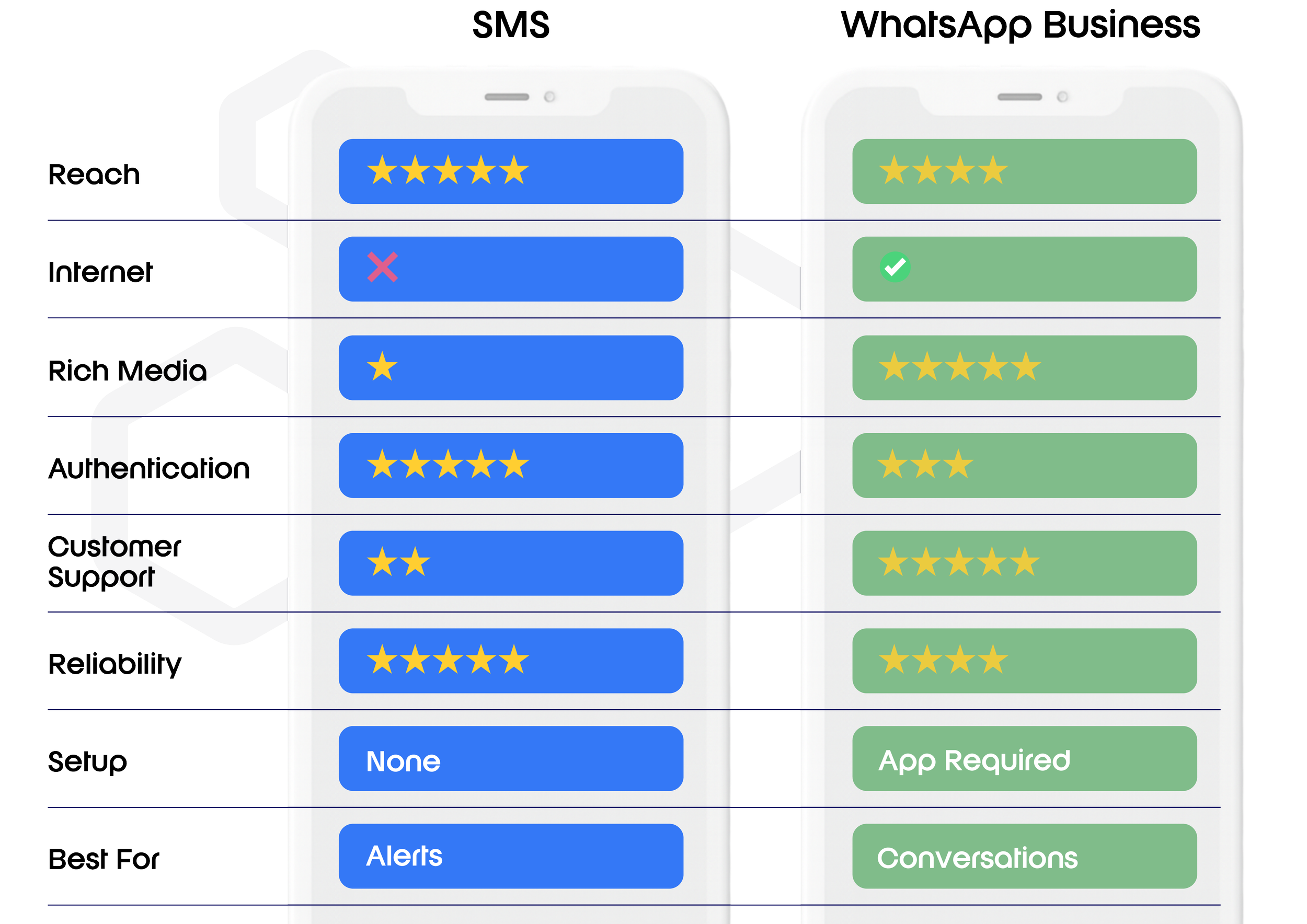
SMS vs WhatsApp Business at a Glance
| Feature | SMS | WhatsApp Business |
|---|---|---|
| Reach | Virtually every mobile phone | Only WhatsApp users |
| Internet connection required | No | Yes |
| Delivery reliability | Extremely high | Dependent on internet access and app availability |
| Rich media support | Limited | Images, video, documents, buttons |
| Customer onboarding | Automatic | User must have WhatsApp installed |
| Authentication use cases | Excellent | Good |
| Emergency communications | Excellent | Limited by app adoption |
| Two-way conversations | Basic | Advanced |
| Global accessibility | Universal | Strong but not universal |
| Enterprise integration | Mature and widely supported | Growing rapidly |
For enterprises, the biggest distinction is simple:
SMS prioritises reach and reliability.
WhatsApp Business prioritises engagement and richer customer interactions.
Understanding this difference is essential before selecting a messaging strategy.
Why SMS Remains the Universal Messaging Channel
SMS has existed for more than three decades. Despite the arrival of countless messaging applications, it remains one of the few communication technologies that works on virtually every mobile device worldwide.
That universality is difficult to replicate.
A customer does not need to download an app, create an account, enable notifications, or maintain a data connection. If their mobile device is connected to a cellular network, they can receive an SMS.
For enterprises, this creates several advantages.
Unmatched Reach
SMS reaches users regardless of:
Device type
Operating system
Mobile application preferences
Internet availability
Smartphone ownership
This is particularly valuable for organisations serving large populations or diverse demographics.
Banks, healthcare providers, government organisations, logistics companies, and utility providers often need confidence that messages can reach every customer, not just app users.
High Open Rates
Industry studies consistently show SMS achieving significantly higher open rates than email.
Customers tend to read text messages quickly because SMS arrives in the device's native messaging application rather than an inbox crowded with promotional content.
For time-sensitive communications, that speed matters.
Examples include:
One-time passwords (OTPs)
Appointment reminders
Delivery updates
Service outage notifications
Fraud alerts
Infrastructure Reliability
SMS operates through established mobile network infrastructure.
As an Ofcom-regulated UK MNO, Stour provides direct SMS connectivity through SMPP and SS7 interconnects, giving enterprises access to highly reliable messaging routes without intermediary complexity.
For businesses where message delivery directly affects customer experience or revenue, network-level reliability often outweighs richer messaging features.
Where WhatsApp Business Offers an Advantage
WhatsApp Business has transformed customer communications by introducing app-based messaging with enterprise capabilities.
Rather than sending a simple text message, organisations can create interactive experiences that resemble conversations within modern messaging applications.
Rich Media and Interactive Messaging
WhatsApp Business supports:
Images
Videos
PDFs
Product catalogues
Interactive buttons
Location sharing
Voice messages
This allows businesses to create significantly more engaging customer experiences.
A retailer can send a product image.
A travel company can send booking documentation.
A support team can guide customers through troubleshooting steps using interactive menus.
SMS cannot provide this level of interaction natively.
Better Customer Service Experiences
Many consumers already use WhatsApp daily.
That familiarity can improve customer engagement.
Instead of calling a support centre or exchanging emails, customers can communicate through a channel they already understand.
This often leads to:
Faster response times
Higher customer satisfaction
Reduced support costs
More efficient issue resolution
Conversation-Based Engagement
WhatsApp excels when communication needs to be ongoing rather than transactional.
Examples include:
Customer support
Sales conversations
Product consultations
Account management
Service enquiries
In these scenarios, the conversational experience often feels more natural than traditional SMS exchanges.
SMS vs WhatsApp Business for Common Enterprise Use Cases
The most effective way to compare SMS vs WhatsApp Business is through real-world enterprise applications.
Authentication and One-Time Passwords
Winner: SMS
Authentication requires speed, reliability, and universal reach.
Users may not have WhatsApp installed.
They may be logging into a new device.
They may not have an internet connection.
SMS remains the preferred channel for:
Two-factor authentication
One-time passwords
Login verification
Account recovery
Delivery Notifications
Winner: SMS (slight advantage)
Delivery notifications often require immediate visibility.
Customers expect updates such as:
Order dispatched
Driver arriving
Parcel delivered
SMS provides near-universal reach.
WhatsApp can also perform well here but depends on application usage and internet access.
Customer Support
Winner: WhatsApp Business
Support interactions usually involve back-and-forth conversations.
WhatsApp's conversational interface, media support, and interactive features create a better experience for both customers and support teams.
Marketing Campaigns
Depends on the objective
SMS works well for:
Time-sensitive promotions
Flash sales
Short offers
High-urgency campaigns
WhatsApp works well for:
Product discovery
Rich media promotions
Interactive shopping experiences
Longer customer journeys
Healthcare Communications
Winner: SMS
Healthcare providers frequently require maximum reach and accessibility.
Appointment reminders, prescription notifications, and urgent patient communications benefit from SMS reliability.
Many healthcare organisations choose SMS because they cannot assume every patient uses WhatsApp.
Financial Services
Winner: SMS
Financial institutions prioritise trust, security, and universal delivery.
Fraud alerts, transaction notifications, and authentication messages are still predominantly delivered through SMS.
Compliance, Security and Regulatory Considerations
Messaging strategy is not solely about functionality.
Compliance requirements can influence channel selection significantly.
SMS Compliance
Businesses using SMS must consider:
Customer consent requirements
Data protection obligations
Industry regulations
In the UK, organisations must comply with relevant privacy and marketing regulations while ensuring responsible messaging practices.
Working with an Ofcom-regulated operator helps enterprises navigate these requirements more effectively. Stour's regulated status, combined with ISO 27001 certification and SOC 2 Type 2 compliance, provides a strong compliance foundation for enterprise messaging services.
WhatsApp Business Compliance
WhatsApp introduces additional considerations.
Businesses must comply with:
WhatsApp Business policies
Template approval requirements
Customer opt-in rules
Meta platform requirements
Unlike SMS, enterprises do not control the underlying messaging ecosystem.
Changes to platform policies can directly affect messaging strategies.
Data Security
Both channels can support secure enterprise communications when implemented correctly.
However, organisations should evaluate:
Data residency requirements
Auditability
Third-party dependencies
Regulatory obligations
For sectors such as healthcare, finance, and government, these considerations often carry equal weight to user experience.
Should Enterprises Choose SMS, WhatsApp, or Both?
For most organisations, the answer is increasingly both.
SMS and WhatsApp Business solve different problems.
SMS provides:
Universal reach
Exceptional reliability
Strong authentication capabilities
Independence from mobile apps
WhatsApp Business provides:
Rich conversations
Enhanced customer engagement
Interactive customer experiences
Media-rich communications
A modern enterprise messaging strategy often combines both channels.
For example:
Send login verification via SMS.
Deliver support communications through WhatsApp.
Use SMS for urgent service alerts.
Use WhatsApp for customer relationship management.
This multi-channel approach allows organisations to match the communication method to the customer's needs and context.
For CPaaS providers, SaaS platforms, carriers, and enterprises operating internationally, flexibility is often more valuable than committing entirely to one channel.
Key Takeaways
The SMS vs WhatsApp Business debate is not about replacing one channel with another.
It is about understanding what each channel does best.
SMS remains the strongest option when reach, reliability, and immediacy matter most. Authentication, alerts, healthcare communications, financial notifications, and critical operational messaging continue to depend on SMS because it works across virtually every mobile device.
WhatsApp Business delivers richer customer experiences through media, interactivity, and conversational engagement. It often excels in customer support, relationship management, and sales interactions.
The strongest enterprise communication strategies combine both channels. By using SMS where certainty is essential and WhatsApp where engagement matters most, organisations can improve customer experience while maintaining dependable communication at scale.
For businesses evaluating enterprise messaging infrastructure, the underlying network matters just as much as the channel itself. As an independent UK MNO regulated by Ofcom, Stour provides direct messaging connectivity, SMS infrastructure, and wholesale telecommunications services that help organisations build reliable communication strategies with confidence.
FAQs
-
Generally, yes. SMS operates through mobile network infrastructure and does not require internet connectivity or application installation. This makes it highly reliable for critical communications such as authentication codes, alerts, and service notifications.
-
Costs vary depending on geography, message volumes, conversation types, and provider agreements. Enterprises should evaluate total communication costs alongside delivery performance, customer engagement, and operational requirements rather than focusing solely on message pricing.
-
Yes. Many organisations use SMS for authentication and urgent notifications while using WhatsApp Business for customer support and engagement. Combining channels often delivers better results than relying on a single messaging platform.
-
WhatsApp Business is typically better suited to customer support because it supports ongoing conversations, rich media, interactive elements, and more natural customer interactions.
-
Banks prioritise reliability and accessibility. SMS works on virtually every mobile phone and does not depend on internet connectivity, making it a dependable choice for login verification, transaction alerts, and security notifications.
If you need reliable SMS delivery, wholesale messaging connectivity, or support for a broader enterprise communications strategy, Stour's technical team can help you evaluate the right approach for your business.
Discuss your messaging requirements with our specialists to explore the most effective channel mix for your customers.