RCS vs SMS for Business Messaging | UK Enterprise Guide
RCS vs SMS for business messaging has become one of the most discussed topics in enterprise communications. Search interest around Rich Communication Services, often shortened to RCS, continues to climb as mobile operators, Android device manufacturers, and messaging platforms push richer mobile experiences into the mainstream.
For businesses already using A2P SMS, the question is no longer whether RCS matters. The real question is where RCS fits alongside SMS in a practical communications strategy.
SMS still delivers unmatched global reach, near universal device compatibility, and predictable delivery. RCS introduces branded messaging, verified sender identities, media support, suggested replies, and app like interactions inside the native messaging inbox.
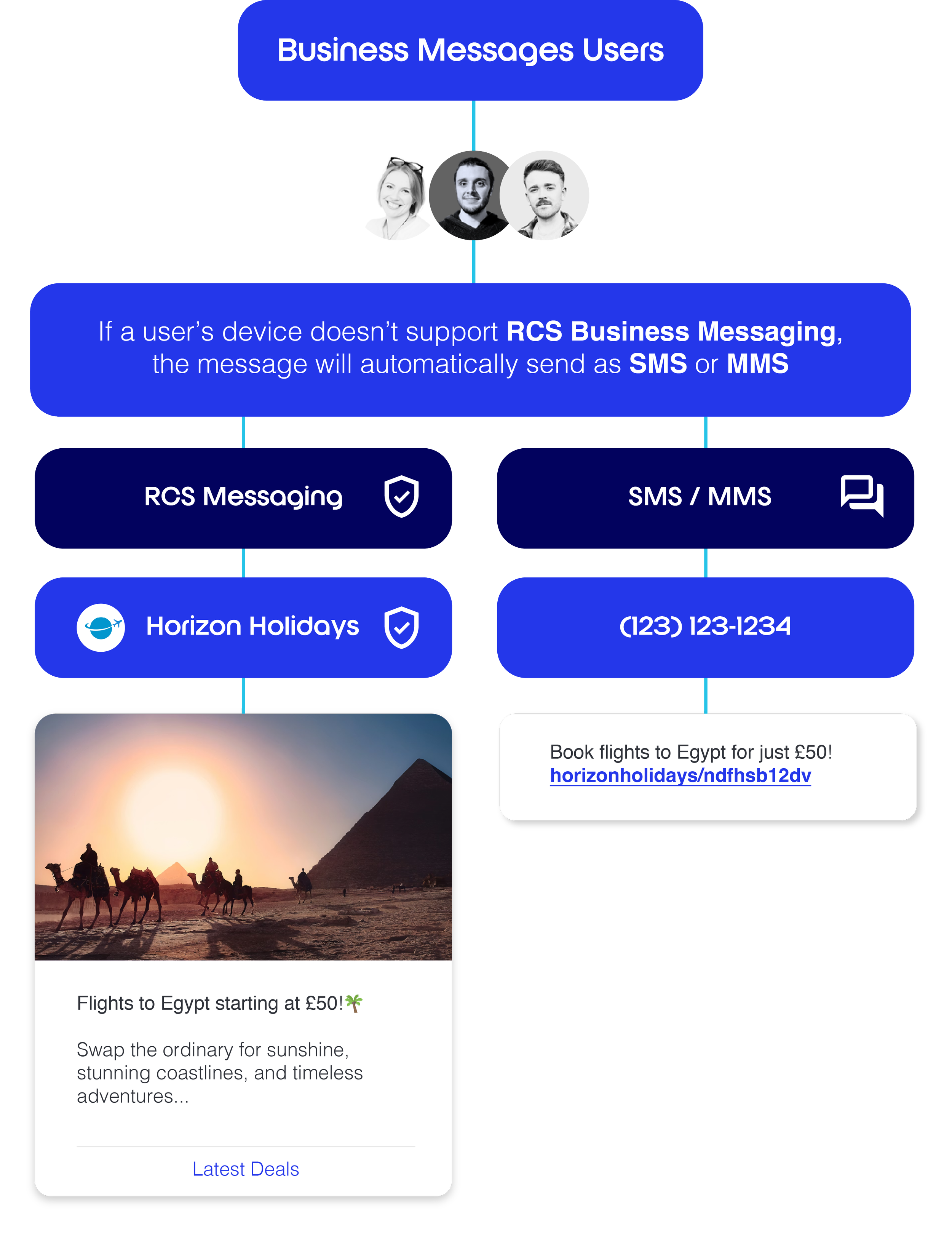
Neither technology replaces the other.
For CPaaS providers, SaaS platforms, international carriers, and enterprise messaging teams, understanding the strengths and limitations of each protocol matters commercially and technically. Routing, handset support, operator interoperability, spam controls, compliance obligations, and fallback mechanisms all affect real world delivery.
As an Ofcom-regulated UK MNO established in 2006, Stour works directly with operators, CPaaS providers, and technology platforms managing large scale messaging traffic. That perspective matters because the practical reality of enterprise messaging is more complicated than marketing material suggests.
Contents
What Is SMS?
SMS, or Short Message Service, remains the foundation of global mobile messaging.
The protocol has existed for decades, but its commercial relevance has not disappeared. Enterprise A2P messaging continues to power authentication codes, delivery notifications, appointment reminders, fraud alerts, customer support updates, and marketing campaigns.
From a technical perspective, SMS uses signalling infrastructure and operator interconnect agreements to route messages between networks. Enterprise traffic typically travels through SMPP interconnects into operator SMSCs before delivery to recipient devices.
The biggest strength of SMS is simple.
Reach.
SMS works across virtually every mobile handset and network worldwide without requiring application downloads, mobile data connections, or platform specific apps. That reliability matters for enterprises sending business critical communications.
For example:
Banks rely on SMS for one time passwords
Logistics platforms use SMS for delivery updates
Healthcare providers send appointment reminders via SMS
Airlines distribute operational alerts through SMS
SaaS platforms use SMS for user verification
Many of these use cases depend on guaranteed compatibility rather than visual richness.
A message that arrives consistently is often more valuable than a message containing interactive media.
What Is RCS Messaging?
RCS stands for Rich Communication Services.
The GSMA developed RCS as an evolution of traditional SMS and MMS messaging. Instead of basic text only communication, RCS supports richer interactions inside the device's native messaging application.
Business messaging through RCS can include:
Brand logos and verified sender identities
Rich media including images and video
Interactive carousels
Suggested replies and action buttons
Read receipts and typing indicators
Rich customer service interactions
Integrated maps and booking flows
In conversation payments or authentication journeys
For consumers, the experience resembles modern messaging apps.
For enterprises, RCS creates a branded communication channel that sits inside the native mobile inbox without requiring a separate application installation.
Google has heavily accelerated RCS adoption through Android integration and partnerships with operators globally. Apple also announced support for RCS messaging standards, which significantly increased industry attention around interoperability and future adoption.
Still, enterprise RCS deployment is not as straightforward as many headlines suggest.
Operator support varies. Handset compatibility varies. Commercial frameworks vary. Security implementations vary.
And unlike SMS, universal global interoperability remains incomplete.
RCS vs SMS for Business Messaging
The difference between RCS and SMS for business messaging becomes clearer when comparing practical enterprise requirements.
Delivery Reach
SMS continues to dominate on reach and consistency.
Almost every mobile phone globally supports SMS. No mobile data connection is required. Enterprise senders can reliably reach users across Android, iPhone, feature phones, roaming devices, and older hardware.
RCS depends on several additional layers:
Compatible devices
Supported messaging applications
Mobile data or WiFi connectivity
Operator interoperability
RCS enabled environments
That means enterprises using RCS must usually maintain SMS fallback mechanisms.
Without fallback routing, delivery gaps appear quickly.
This is particularly important for:
Authentication traffic
Emergency alerts
Time sensitive notifications
International enterprise messaging
Regulated communications
Message Experience
RCS offers a substantially richer user experience.
SMS is fundamentally text based. Links and shortcodes provide limited interaction capabilities, but the protocol itself was not designed for interactive enterprise engagement.
RCS changes that.
A retailer can deliver product carousels directly inside the messaging thread. Airlines can provide live boarding passes. Customer support teams can create guided interactions using buttons and suggested responses.
For marketing and engagement campaigns, RCS creates stronger opportunities for:
Higher interaction rates
Better visual branding
Improved customer trust
Richer customer journeys
Reduced app dependency
That does not automatically mean higher conversion.
The effectiveness still depends on audience, device support, campaign design, and delivery consistency.
Security and Trust
Business messaging fraud remains a major issue across global telecom networks.
SMS phishing, spoofing, and grey route abuse continue to affect enterprise messaging quality. Operators globally, including UK networks, have increased filtering and fraud controls in response.
RCS business messaging introduces verified sender identities, which can improve consumer trust.
Verified branding helps recipients distinguish legitimate enterprise traffic from fraudulent impersonation attempts.
However, RCS security models depend heavily on ecosystem implementation. Operator partnerships, platform governance, and verification standards all affect the actual security posture.
SMS remains deeply trusted for operational communication because enterprises already understand its behaviour, routing patterns, and compliance frameworks.
For highly regulated industries such as banking or healthcare, predictability often matters more than interface sophistication.
Cost Structure
SMS pricing models are mature and widely understood.
Wholesale SMS pricing typically depends on:
Destination network
Traffic type
Interconnect structure
Direct versus indirect routing
Volume commitments
Regulatory environment
RCS pricing structures remain less standardised globally.
Commercial agreements vary between operators, aggregators, and platform providers. Some deployments operate on session based models, others on conversation windows or message events.
That variability creates planning challenges for international carriers and enterprises operating across multiple regions.
For businesses with predictable operational messaging requirements, SMS often remains commercially simpler.
Reliability
Enterprise messaging teams care about delivery consistency more than feature lists.
SMS infrastructure has decades of operational maturity behind it.
Routing paths, filtering behaviour, delivery reporting, and international interconnect frameworks are broadly understood across the industry.
RCS infrastructure remains newer and less uniform.
Some markets show strong operator adoption. Others rely heavily on platform driven implementations. Interoperability between operators and messaging ecosystems still develops unevenly.
For this reason, many enterprises currently treat RCS as a complementary engagement channel rather than a replacement for SMS.
Where SMS Still Performs Better
Despite industry excitement around RCS, SMS continues to outperform in several critical enterprise scenarios.
Authentication and One Time Passwords
OTP delivery depends on speed, reliability, and broad compatibility.
SMS remains the preferred channel for many authentication workflows because users do not need:
Data connectivity
Specific messaging applications
Device updates
Advanced handset support
RCS adoption is improving, but authentication systems require maximum predictability.
A failed login code creates immediate operational friction.
International Messaging
Global enterprise messaging depends on consistent interconnect coverage.
SMS already benefits from decades of international carrier relationships and routing frameworks. Operators, wholesale carriers, and CPaaS providers understand how to manage SMS traffic internationally.
RCS interoperability across international networks is less mature.
For international carriers entering the UK market, SMS still provides a more predictable operational environment.
Low Bandwidth Environments
SMS works in conditions where mobile data connectivity may be weak or unavailable.
That matters for:
Rural coverage
International roaming
Congested network conditions
Older devices
Operational field teams
RCS depends on IP connectivity.
No data connection usually means no RCS experience.
Operational Messaging
Many enterprise notifications do not need visual interaction.
A delivery confirmation does not need a carousel.
A fraud alert does not need branded graphics.
A utility outage notification does not need embedded media.
In these cases, SMS remains highly effective because it delivers concise information reliably.
Where RCS Creates New Opportunities
RCS becomes far more compelling in customer engagement scenarios.
Retail and Ecommerce
Retailers can create interactive shopping journeys directly inside messaging threads.
Instead of sending a shortened URL through SMS, brands can:
Display product imagery
Offer one tap purchase journeys
Surface stock availability
Present interactive promotions
Guide customer service conversations
For some sectors, that creates measurable engagement improvements.
Customer Support
RCS allows enterprises to build conversational customer support experiences without forcing users into separate applications.
Suggested replies and interactive menus reduce friction.
Customers remain inside their native messaging environment while still accessing richer support interactions.
Brand Trust
Verified sender branding can improve customer confidence.
Consumers increasingly question unknown SMS senders because phishing attacks remain common.
RCS business verification provides:
Brand names
Official logos
Verified business indicators
That visibility may improve engagement and reduce fraudulent impersonation risks.
Rich Media Campaigns
Marketing teams gain access to media rich communication without requiring app installs.
This is one reason Google and major operators continue pushing RCS adoption.
The channel attempts to bridge the gap between traditional SMS and over the top messaging applications.
UK Regulatory and Technical Considerations
Any discussion around RCS vs SMS for business messaging should include compliance and regulatory realities.
UK telecom regulation continues evolving around spam prevention, fraud reduction, and customer protection.
As an Ofcom-regulated MNO, Stour sees increasing scrutiny around:
Sender verification
Spam filtering
Artificially inflated traffic
Fraud prevention controls
International routing quality
Consumer protection obligations
These issues affect both SMS and RCS.
For enterprises operating in the UK market, technical delivery alone is no longer enough. Messaging providers must also demonstrate:
Compliance readiness
Security controls
Responsible routing practices
Transparent interconnect relationships
This becomes particularly important for CPaaS providers and international carriers delivering enterprise traffic into UK networks.
Security frameworks also matter.
Enterprise buyers increasingly require infrastructure providers to demonstrate ISO 27001 certification and SOC 2 compliance before onboarding messaging traffic.
For highly regulated sectors, messaging reliability and governance often outweigh feature expansion.
Why Most Businesses Will Use Both
The market discussion sometimes frames RCS and SMS as competitors.
In reality, most enterprise messaging strategies will use both technologies together.
SMS remains the universal fallback and operational backbone.
RCS adds richer interaction where device support and customer experience requirements justify it.
That hybrid model already appears across major enterprise deployments.
A business may use:
SMS for authentication
SMS for urgent operational alerts
RCS for promotional engagement
RCS for customer support interactions
SMS fallback for unsupported devices
This layered approach reflects how enterprise telecom infrastructure normally evolves.
New protocols rarely replace existing infrastructure immediately.
They extend capabilities gradually while businesses maintain compatibility and operational resilience.
For wholesale telecom providers, CPaaS platforms, and SaaS businesses embedding communications, the practical priority is flexibility.
That means:
Direct operator relationships
Reliable interconnect agreements
Strong SMS routing quality
RCS capability where commercially viable
Transparent compliance processes
Scalable infrastructure
As an independent UK MNO, Stour provides wholesale SMS, voice, numbering, and interconnect services for businesses operating across these environments. Direct operator relationships and regulated infrastructure help enterprises maintain visibility into routing quality and compliance obligations while adapting to evolving messaging standards.
FAQs
-
No.
RCS expands messaging functionality, but SMS still provides broader global compatibility and operational reliability. Most enterprises currently use SMS and RCS together rather than replacing SMS entirely. Authentication, emergency notifications, and operational alerts continue relying heavily on SMS because delivery reach remains stronger.
-
The biggest advantage is richer customer interaction inside the native messaging inbox. Businesses can use verified branding, images, suggested replies, and interactive customer journeys without requiring separate mobile applications. That can improve engagement for customer support and marketing use cases.
-
SMS remains highly reliable because nearly every mobile handset and network supports it. No mobile data connection or application installation is required. For enterprise messaging teams managing authentication traffic, operational alerts, or international communication, predictable delivery often matters more than advanced visual features.
-
Apple announced support for RCS standards, which increased industry adoption momentum. However, implementation details, interoperability behaviour, and enterprise support models continue evolving. Businesses should still maintain SMS fallback routing for maximum compatibility.
-
RCS business messaging can improve trust through verified sender identities and branded messaging experiences. However, actual security depends on platform implementation, operator relationships, and governance controls. SMS remains heavily used in regulated industries because its operational behaviour and compliance frameworks are well understood.
-
Retail, ecommerce, travel, and customer support environments often gain the most value from RCS because rich media and interactive messaging improve customer engagement. Businesses focused on operational messaging, authentication, or low bandwidth delivery may still prioritise SMS.
Key Takeaways
RCS introduces richer mobile messaging experiences that create new engagement opportunities for enterprises.
SMS remains the most universally compatible and operationally reliable mobile messaging channel.
For most businesses, the future is not RCS or SMS.
It is RCS and SMS working together.
Enterprises evaluating messaging infrastructure should focus less on hype and more on practical delivery requirements:
Device compatibility
International reach
Regulatory compliance
Routing transparency
Fraud prevention
Operational resilience
Commercial predictability
Messaging technology continues evolving, but enterprise communication still depends on one principle above everything else.
The message has to arrive.
Businesses evaluating UK messaging infrastructure, SMPP interconnect, or wholesale SMS routing can discuss requirements directly with Stour's technical team.